Opinion
ZACHOR
I am a proud 9/11 rabbi




 Add EJP on Google
In Short
For all of us who are old enough to remember it, 9/11 forever changed us.
On the morning of my first day of classes in my third year of rabbinical school, two Boeing 767s struck the Twin Towers. I had just come back from my year in Israel, where I lived through the terror of the Second Intifada. Now an even larger global event would come to define not just my experience at the Reconstructionist Rabbinical College, but my rabbinate as a whole.
I am a 9/11 rabbi through and through. The lessons learned from that horrific day have helped determine the type of work I have taken on, my approach to Judaism and my understanding of my role as a rabbi in the greater world. The first time I led High Holy Day services was five days after 9/11; this week, Erev Rosh Hashana falls on the 25th anniversary.
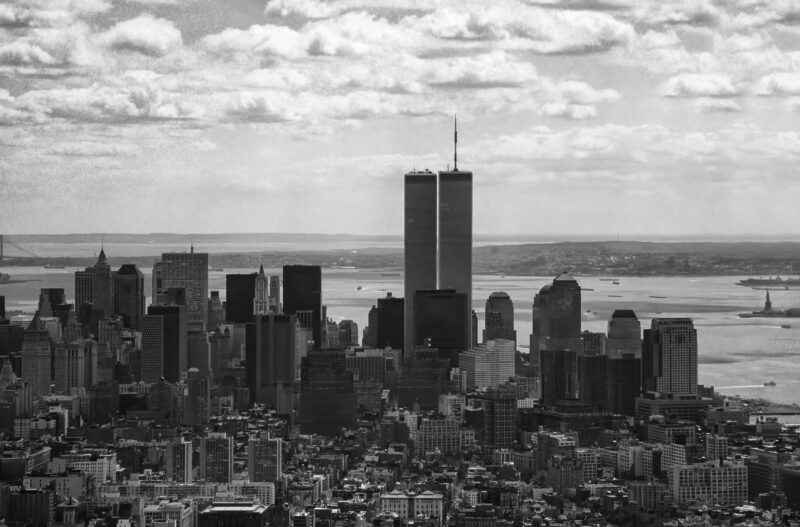
Stein Photo/Getty Images
Historic black-and-white panoramic view of Lower Manhattan centered on the original World Trade Center Twin Towers, with New York Harbor, the Statue of Liberty and distant shoreline visible beyond the city skyline.
Here are three meaningful ways 9/11 helped shape my rabbinate:
First, it taught me flexibility and the value of being responsive to the moment.
I had worked for weeks and weeks on the sermon that I would give that Rosh Hashana. I honed it. I tweaked it. I finally felt comfortable with it. Yet on Sept. 12, 2001, that perfectly crafted speech went into the waste bin, never to be seen again.
The world was in disarray in the days and weeks that followed 9/11. The student pulpit I was serving in Atlanta needed to hear a message of hope and resilience, stability and assurance. I spoke about the stones of the ancient Temple that still line the grounds of the Jewish Quarter and of the thousands of years of understanding we have about how to recover from tragedy. It was not the best sermon I would ever offer, but it was one of the most important. Through that experience, I learned to wait a little longer to start writing, and when I do, to be responsive to the moment we are living through.
Second, 9/11 taught me about how interconnected we were with the larger world.
While the Second Intifada was a blaring shofar cry across the Jewish world, Sept. 11, 2001 was an even louder cry across the whole of the world. There are more than 1,200 9/11 memorials around the globe, located everywhere from Hangzhou, China, to Arazim Park in Jerusalem. To be a post-9/11 rabbi, I would need to acknowledge that the Jewish community is a small dot on the landscape of the wider world. Tikkun olam, repairing the world, suddenly extended beyond just tending to our own community needs to critical issues affecting the planet.
Third, 9/11 taught me that relations with non-Jewish partners are essential.
Because religious fanaticism was at the core of the attack, 9/11 exposed the fault lines not just between the Abrahamic religions but between all religious groups. As a rabbinical student, I saw the way my Muslim friends and neighbors were being targeted. Islam and Judaism were both minority religions in America, and it would be my job to reach out and support my fellow religious travelers in their time of need. Right away, I started Jewish-Muslim-Christian programming, attended interfaith Thanksgiving services and began to create a network that has only expanded over the years. Currently, I serve as the rabbinic advisor to the Community Relations Council of the Buffalo Jewish Federation, interfacing with hundreds of contacts around western New York. I am not sure I would be in such a role without the influence of 9/11.
For all of us who are old enough to remember it, 9/11 forever changed us. While a quarter century has now passed, the lessons learned from that fateful day continue to shape our personal lives and those of our communities. May the souls of the 2,977 people who lost their lives in the terrorist attacks on Sept. 11, 2001 always be for a blessing.
Rabbi Alex Lazarus-Klein is the rabbi of Congregation Shir Shalom in Buffalo, N.Y.