Encountering Global Jewish Millennials: Nahum Goldmann Fellowship




 Add EJP on Google
By Steven Windmueller, Ph.D.
There is something compelling and extraordinarily impressive about Millennials. I had occasion this past week to work with a number of these 25-40 year olds. The range of their experiences, interests, and even accomplishments is significant, but more profound, would be their Jewish commitment and passion.
Millennials demonstrate their unique and accomplished position within their respective societies and on behalf of the Jewish people as they employ the full measure of their talents and resources. These are individuals who traverse the world, manage multiple languages, recount life-changing encounters, and demonstrate a rich and diverse exposure to cross-cultural ideas. They provide a sobering yet reassuring belief in the capacity of this generation to create a profound impact on shaping the Jewish discourse. Their careers demonstrate their striking desire to reinvent professions and recreate Jewish communities.
I had occasion to teach and mentor a number of these global citizens as part of the 30th Nahum Goldmann Fellowship, a project of the Memorial Foundation for Jewish Culture. Last year, on these pages, I wrote about the NGF itself as a remarkable gathering.
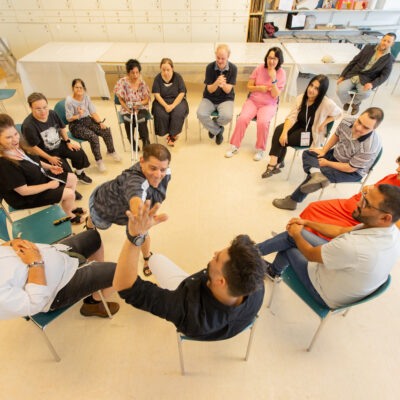
Several of the Goldmann Fellows have spent time on multiple continents, while others have encountered experiences that few baby boomers or matures could have imagined. A significant number of them are working on cutting edge issues and projects, while others, even at their youthful age, are literally changing communities and impacting societies. Yet, their knowledge of and connection to Judaism seem to operate in contradiction to the generational characteristics of their peers. What is profoundly impressive, these leaders-in-formation care deeply about the future of Jewish peoplehood. Their backgrounds are strikingly different, not only geographically but most certainly culturally, religiously, and politically as they reflect the diversity of world Jewry. Can you imagine a human resource specialist from India, a human rights attorney from South Africa, a fashion designer from Los Angeles, or a dentist from Guatemala, in addition to a teacher from Mexico? What they share in common is a profound interest in and overarching commitment to the continuity of the Jewish people.
An English banker, now living in Tel Aviv, is working on the next great Jewish financial and investment idea! An environmentalist from the States is focusing his energies on applying Jewish principles and teachings to global sustainability. A diplomat from Australia through her personal example of Jewish practice and activism models and informs for the folks she encounters in Muslim lands and beyond, what Judaism represents.
Beyond sharing their love of Judaism, the connective features that bind these men and women together are instructive:
- Youth movements that transformed them.
- Individual teachers, rabbis, and activists who inspired them.
- Families and friends who embraced them and gave them an anchor to explore and affirm their identity and communal connections.
- Experiences and events that defined them.
- Ideas, books and texts that spoke to them and informed them.
During our seminar, these accomplished participants would be particularly grateful for all that “the faculty” would have to share with them, but in many ways those of us privileged to teach these Millennial Jewish representatives were the primary learners. After all, their insights were reflective of widely different experiences than our own and their passion for learning would ennoble and challenge our own.
Learning most often occurs in safe spaces, yet this particular educational encounter involving 32 participants from 17 countries would take place in Germany. Indeed, over these post war years, many Jewish groups have conducted programs in that nation. For the Memorial Foundation for Jewish Culture, this would represent their first foray into modern Germany. The physical act of visiting the site of a former concentration camp would itself be a difficult, yet powerful learning moment. For a generation that is removed from the memories and stories of 1933-1945, this encounter would be critical in shaping their own ideas and connections with the Holocaust.
While their orientation and outlook as global Jews are fundamentally different from previous iterations of our community, they are seeking to reconstruct the Jewish experience, modulating its particular characteristics with the rhythms of the general social culture. I for one am looking with great anticipation as these individuals move their careers and lives forward, shaping and informing the Jewish world.
Steven Windmueller is the Rabbi Alfred Gottschalk Emeritus Professor of Jewish Communal Studies at the Jack H. Skirball Campus of the Hebrew Union College-Jewish Institute of Religion, Los Angeles.