WHAT YOU SHOULD KNOW
‘A time to laugh, a time to weep’: Midterms offer U.S. Jews a mixed bag
Joe Lamberti/Getty Images
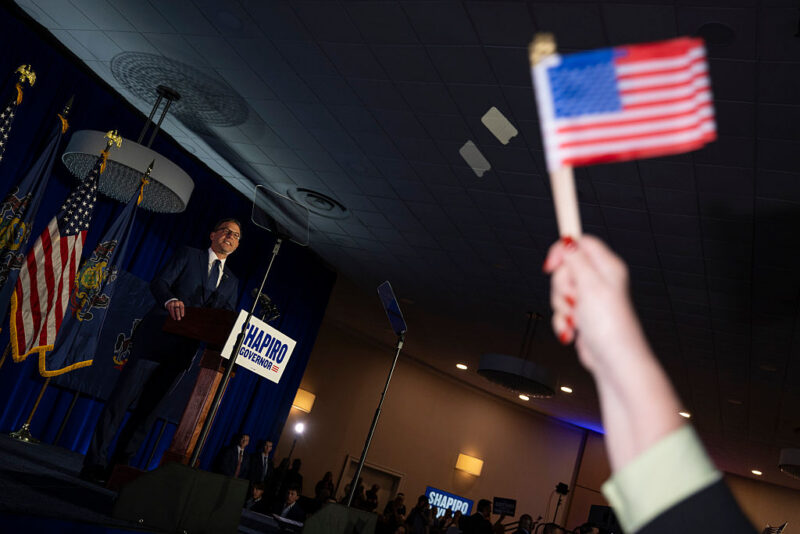
Democratic Gov. Josh Shapiro declares victory during a speech at an election-night event at the Penn Harris Hotel in Harrisburg, Pa., on Nov. 3, 2026.


 Add EJP on Google
As Democrats routed the GOP in yesterday’s midterm election, giving them control of both the House and the Senate — along with the governorships of several large states — the American Jewish community will have cause to celebrate and cause for concern in the years to come.
An NBC News exit poll found that, nationally, some two-thirds of Jewish voters cast their ballots for Democratic candidates — an indication that the party remains the main political home of the American Jewish community. Issues like immigration, reproductive rights and civil rights still appear to bind the Jewish community to the Democratic Party, even as there is growing disagreement over Israel and how to respond to soaring antisemitism.
However, in the coming days and weeks, a clearer picture will likely emerge of how the Jewish vote split in specific contentious races. This will be particularly significant in the Michigan Senate race that saw Abdul El-Sayed beat out Republican Mike Rogers, despite significant Jewish concerns about El-Sayed’s views on antisemitism and opposition to Israel, which he made a key element of his campaign. A poll of early voters by The Jewish Majority found a sharp difference in support among Michigan Jews for El-Sayed, with 57% saying that they voted for him, compared to the 78% who cast their early ballot for Democratic candidate for governor, Jocelyn Benson, who won her race.
As of Wednesday morning, it is still too early to call the Los Angeles mayoral race, in which Nithya Raman — an avowed anti-Zionist who campaigned with antisemitic influencer Hasan Piker — has a slight lead over incumbent Mayor Karen Bass.
This cycle also saw the election of five candidates officially aligned with the Democratic Socialists of America, a group that deeply opposes Israel and American support for it: Chris Rabb in Pennsylvania; Darializa Avila Chevalier and Claire Valdez in New York; Melat Kiros in Colorado; and Donavan McKinney in Michigan.
In addition, several GOP lawmakers with direct connections to white nationalists and neo-Nazis have won or retained seats in state legislatures and the House of Representatives. They include: Marshall Rawson, a participant in the deadly 2017 neo-Nazi rally in Charlottesville, Va., who won a seat in Florida’s state Legislature; Wendy Rogers, who spoke at neo-Nazi Nick Fuentes’ America First Political Action Conference in 2022 and was reelected to Arizona’s state Senate; and Paul Gosar, who has similarly maintained a yearslong relationship with Fuentes and appeared at his America First conferences and has been reelected in Arizona’s 9th Congressional District.
Providence, R.I. — home to nearly 200,000 people, among them some 15,000 Jews — also overwhelmingly passed a ballot measure demanding that it divest its municipal funds from “foreign countries conducting ethnic cleansing, apartheid, illegal military occupation, or genocide.” Though the measure did not name Israel directly, it was championed by explicitly anti-Israel groups. (Even with its passage, it is not yet clear if the ballot initiative will be implemented at all, and if it will also be directed against other countries accused of such crimes, such as China, Turkey and Morocco.)
Alongside these potentially worrying developments for the mainstream Jewish community, yesterday also saw the election of key members and allies. Perhaps most significant of these is Pennsylvania Gov. Josh Shapiro, who is projected to win the commonwealth with more than 60% of the vote, according to the latest Associated Press tally. This is a particularly notable victory as Pennsylvania has historically been a swing state, and Shapiro’s strong showing will likely serve as a key piece of evidence as Democrats consider whom to nominate for the 2028 presidential campaign.
Democratic Majority for Israel also celebrated the long list of pro-Israel moderates who won, including Reps.-elect Elaine Luria (D-VA), Brad Schneider (D-IL), Cait Conley (D-NY), Marni von Wilpert (D-CA), Bobby Pulido (D-TX) and Juan Vargas (D-CA). “Pro-Israel Democrats are leading the wave!” DMFI wrote on X.
Yesterday’s Democratic victory will also likely see Sen. Chuck Schumer (D-NY), now the chamber’s minority leader, named as Senate majority leader. Rep. Hakeem Jeffries (D-NY) will also likely serve as House speaker and thus the first Black speaker in U.S. history. Though they are not universally beloved by all parts of the Jewish community — particularly not its more conservative wing — as New York Democrats, both Schumer and Jeffries have long maintained ties to the Jewish community and repeatedly voiced support for the United States’ relationship with Israel, even as they have frequently criticized its current government.
In New York, a minyan’s worth of Orthodox men was also elected to the state’s legislature, David Greenfield, CEO of the poverty-fighting Met Council and former Democratic lawmaker, noted on X.
While the American election season is now winding down, Israel remains in the thick of its political reshuffling. Earlier today, President Isaac Herzog received the verified results from last week’s elections, and this afternoon, he will start meeting with the various parties to hear their endorsements for Israel’s next prime minister.
Neither outgoing Prime Minister Benjamin Netanyahu nor his main opponent, Gadi Eisenkot, currently has a clear majority in the Knesset. Eisenkot has indicated plans to use the majority in the Knesset that is opposed to Netanyahu to advance certain legislation, even as obstacles remain in forming a stable government.